

My Journey Creating Filibot: How a Simple Idea Became a Learning Ecosystem

Filibot - ExoSpace

When I look back at the first day Filibot took shape in my mind, it feels almost unreal. What started as a simple conversation about learning in grassroots schools slowly grew into a full learning ecosystem that now reaches thousands of students across Meghalaya and Ladakh. The scale of it still surprises me, but the journey to get here is something I will always remember.

Filibot began as a small idea during my collaboration with Cheenta Academy and The Filix School of Education. We were just a handful of students trying to figure out how hands-on learning, games, and technology could work together in schools that often lacked access to interactive resources. I remember our first meeting clearly. It felt like we were stepping into something meaningful but had no idea how large it would eventually become.

Where It Started for Me

Where It Started for Me

I have always believed that learning should feel natural. Children should be able to touch, play, fail, and try again. My early schooling years and my work in teaching younger students taught me that curiosity grows when students are not forced to memorize but encouraged to explore. When Filibot began, this belief quietly guided every decision I made.

The earliest phase was scrappy and exciting. Our tiny team, with Ayaan, Abhirath, and me working across screens, tried to build activities that were simple, affordable, and actually fun. Shadow Tracker, Tangram Puzzles, DIY Water Filter. These small experiments became the backbone of Filibot’s activity library. They taught me that creativity does not need fancy materials. It needs intention.

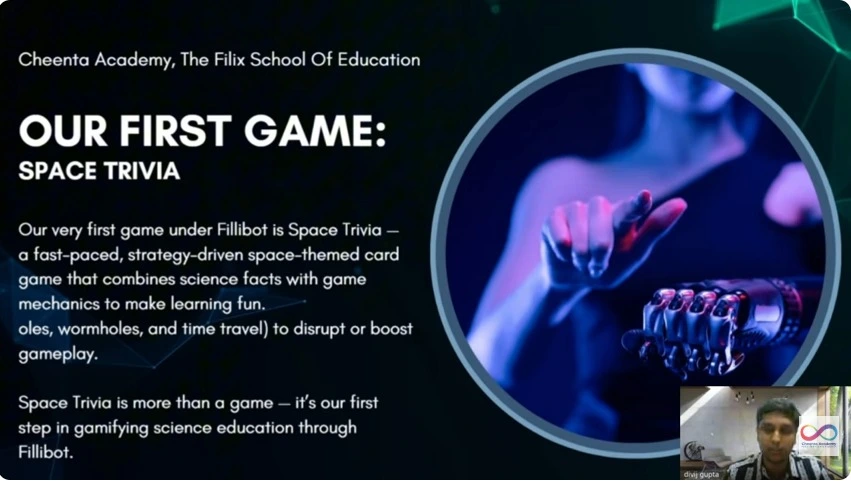
Around the same time, I came up with the idea for Space Trivia. I wanted students to feel the same wonder I felt as a child when I first looked up at the night sky. My fascination with astronomy came rushing into this game. Each card had facts about planets, stars, exoplanets, and moons. Building it felt like combining a childhood dream with real scientific thinking. I could finally share the joy of comparing gravity or mass across celestial bodies with students who may have never had an astronomy class.

This was the moment Filibot stopped being a simple school project and started becoming a mission.

Also Read: Walking​‍​‌‍​‍‌​‍​‌‍​‍‌ Through History, Listening to Identity: My Journey of Writing a Research Paper on Tibet

Understanding Why Filibot Was Needed

As we dug deeper into the challenges schools faced, especially in underserved regions, I became more aware of how scarce interactive learning resources really were. Many children were being taught in a system that rewarded memorization even though they craved exploration.

Teachers were dealing with limited data, outdated systems, and overworked schedules. Schools often kept student records in fragmented formats. Predicting learning gaps or planning interventions was almost impossible. I realised that Filibot could help. Not by replacing teachers but by giving them a supportive infrastructure that worked quietly in the background.

This was when the idea of integrating data analytics into Filibot was born.

The Shift to Data and AI

To be honest, this part scared me at first. Working with real-world school data, especially datasets from Meghalaya and Ladakh, felt like a responsibility much bigger than I expected. The data was messy and full of inconsistencies. I spent hours cleaning, standardizing, and structuring it so that it made sense. Outliers had to be analysed, missing values treated, patterns identified.

Pivot tables became my closest companions. Scatter plots told stories that raw numbers never could. Correlation coefficients showed me exactly how powerful early assessments were in predicting final outcomes. Watching numbers turn into insights that could change how teachers viewed learning progression was nothing short of magical.

That was when I understood the true potential of Filibot. It could become a bridge between playful engagement and evidence-based decision making.

Also Read: Emerging Trends in Automation and Robotics

Building the Games and Activities

It still surprises me how many activities we ended up creating. Invisible Ink Spy Notes, Chromatography Art, Earthquake-Proof Structures, Balloon-Powered Cars, Floating Paper Clip. Each one felt like a tiny world of learning on its own.

Designing Space Trivia was a joy. Creating Math Football and Eco Quest taught me how a game can teach math, strategy, and environmental awareness without feeling like a lesson. The more we built, the more confident I felt that learning and play could coexist beautifully.

The Website and Platform

The Website and Platform

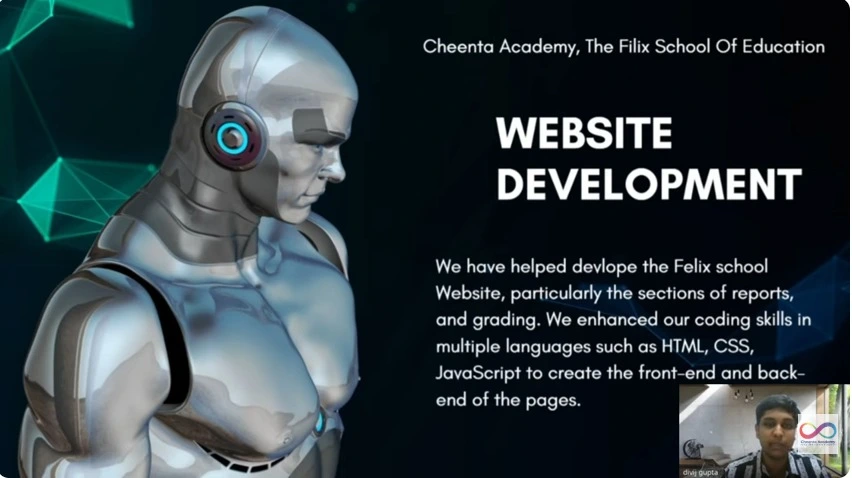
When I joined the team working on the Filix School platform, it felt like we were finally building the home Filibot deserved. The platform needed to be simple enough for a young student to navigate, but powerful enough to carry AI insights and competency-based tracking.

Designing the report card interface was one of my favourite parts. I wanted children to see more than just marks. I wanted them to see skills like collaboration, creativity, and communication as real achievements. Watching the competency–skill pairing system come alive felt like solving a puzzle I did not know I could crack.

The Real-world Deployment

The day I learned that Filibot was being used across 57 schools in Meghalaya and 70 schools in Ladakh felt surreal. It was no longer a project restricted to my screen or notebook. It was now in the hands of thousands of students.

It is humbling to think that something I helped build is being used by 38,972 students and 2,609 teachers. These numbers are not just statistics. They represent children who laugh while playing Space Trivia, teachers who finally have clarity on student progress, and classrooms where learning feels alive.

Also Read: Leading the English Debating Society

What I Struggled With

What I Struggled With

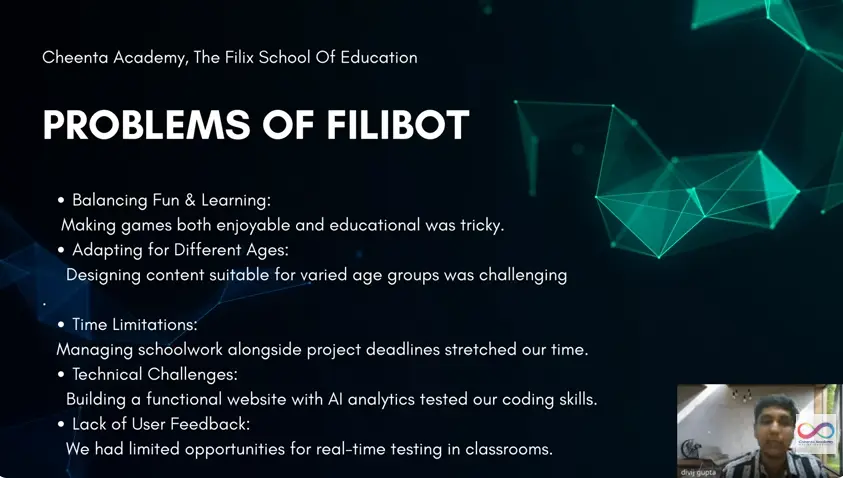
No project grows without challenges. Balancing fun with real educational rigor was often stressful. There were nights I worried the activities were too easy or that the games were too distracting. Data cleaning sometimes felt endless. Technical limitations forced us to rethink ideas again and again.

But each problem pushed me to think creatively. I learned the value of step-wise development, role-based teamwork, and constant pilot feedback. Every challenge became a quiet teacher.

What Filibot Means to Me Now

Filibot is more than a project. It is a piece of me. It is a reflection of what I believe learning should feel like. It represents the children who deserve better educational experiences and the teachers who work tirelessly behind every classroom door.

I have grown with it. I learned leadership, patience, scientific curiosity, and the importance of designing with empathy. Every activity, every card, every data point carries a memory of the hours I spent imagining how a student might interact with it.

Looking Ahead

Looking Ahead

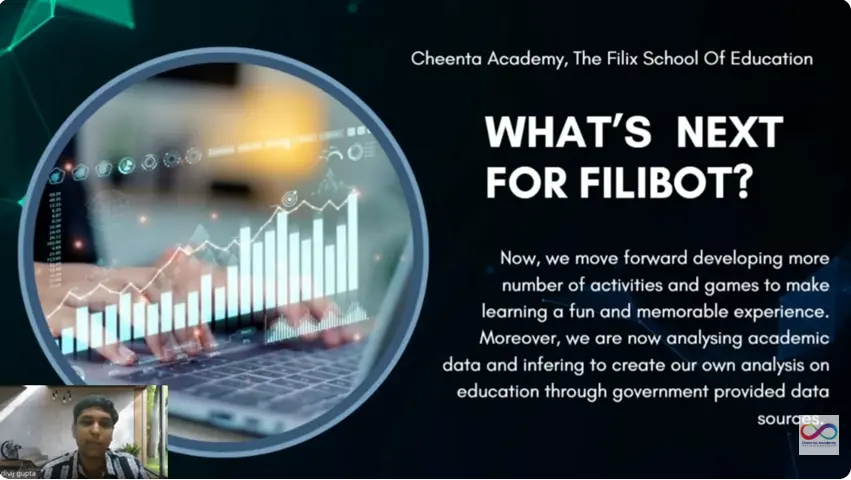
There is still so much more I want Filibot to become. A larger activity library. More games. A stronger AI engine. Integration with government datasets. Predictive models that track learning across semesters. Real-school deployment on a massive scale.

I no longer see these as ambitious dreams. I see them as the next steps in a journey already unfolding.

Why This Journey Will Stay With Me

Filibot is a project I poured myself into. It taught me what it means to build something meaningful. It taught me to think like a researcher, a designer, a teacher, and a student all at the same time. Most of all, it taught me that learning can be joyful, playful, and deeply empowering if we design it with care.

Whenever I think about the children using Filibot today, I feel an unexplainable sense of gratitude. Their curiosity keeps this project alive. Their excitement reminds me why I started all this in the first place.

This is not the end of the journey. It is only the beginning.

Latest Blogs

Divij Gupta English Debating Society - ExoSpace

Leading the English Debating Society

Principal, Ma’am Kain: “After how many years, Divij?” Divij: “Seven years, Ma’am.” I don’t think I’ll ever forget that exchange. It all happened in the stillness of the Activity Centre, just moments after we lifted the Ms. Oliphant Memorial Debates Trophy after seven long years. The hall buzzed with applause,